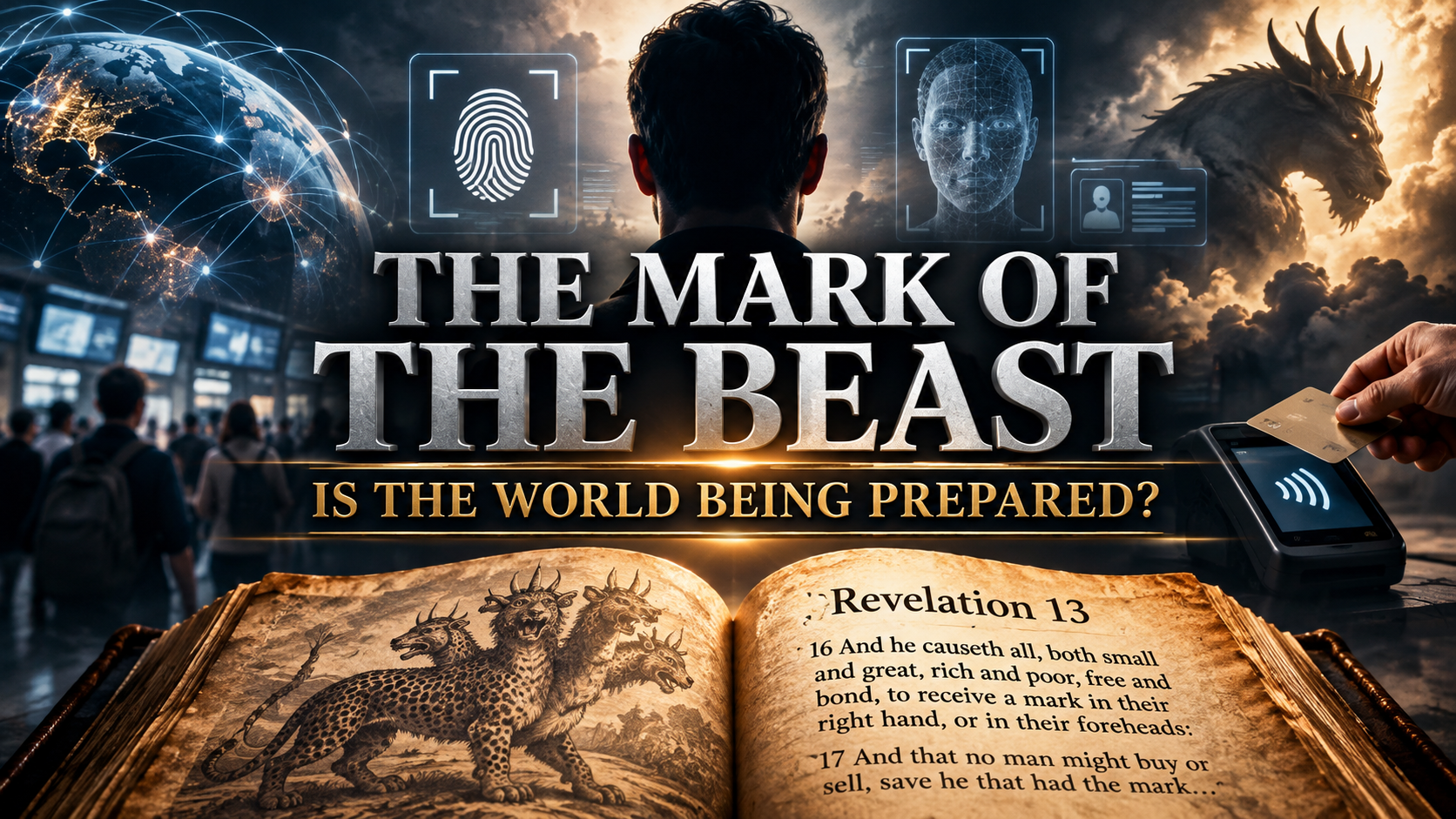
What Is the Mark of the Beast in Revelation 13?
Imagine a world where participating in everyday economic life requires more than having money. Your identity must be verified, transactions authorized, and access approved. Revelation 13 describes something more serious: buying and selling restricted in connection with allegiance to the beast.
Are modern technologies making that scenario easier to imagine? Yes. Does that prove the prophecy is being fulfilled? No. We must begin with what Scripture actually says.
Revelation 13:16–18 describes a mark on the right hand or forehead and connects commerce with the name or number of the beast. But the surrounding passage also describes deception, coerced worship, and persecution. The central question is not simply how people transact. It is whom they worship and obey.
The beast also appears in Revelation 11 as the enemy who kills God’s witnesses after their testimony is complete. Our study of the two witnesses in Revelation 11 examines that conflict and explains why Christians differ about the witnesses’ identities.
Why Does Revelation Connect the Mark to Buying and Selling?
Revelation 13:17 says that buying and selling are restricted to those with the mark, name, or number. Modern payment networks, identity systems, and account permissions show how access can be controlled at scale. Those capabilities make the scenario imaginable without identifying any current technology as the mark.
The biblical passage describes authority and worship as well as economic exclusion. A system capable of denying a transaction is not automatically the system John describes.
Does the Bible Say the Mark Will Be a Microchip?
No. Revelation does not name a microchip, barcode, smartphone, vaccine, digital wallet, or biometric identifier. Such claims are later interpretations, not explicit statements in the text.
Some futurist Christians anticipate a literal mark connected to a future ruler. Others understand the imagery symbolically as allegiance to power opposed to God. Neither view can responsibly claim that Revelation identifies a particular modern device.
Why the Right Hand and Forehead?
Deuteronomy 6:6–8 connects devotion to God’s words with the hand and the space between the eyes. Revelation 7:3 describes God’s servants receiving a seal on their foreheads, while Revelation 14:1 portrays the Lamb’s people bearing divine names.
This contrast leads some interpreters to see the beast’s mark as a counterfeit sign of belonging and loyalty. Others expect a literal future expression. Both must explain the recurring emphasis on allegiance.
What Does the Number 666 Actually Mean?
Revelation 13:18 calls for wisdom and gives the number 666. A historical interpretation connects it to Nero Caesar through numerical values assigned to Hebrew letters. The ancient variant 616 is relevant because a different spelling of Nero’s name can yield that number.
That is a serious historical proposal, not a settled identification accepted by every interpreter. Preterist readings emphasize Roman imperial power, futurist readings often anticipate a final ruler, and idealist readings highlight recurring human rebellion against God. Numerical tricks that can be made to identify nearly anyone are not reliable evidence.
For scholarly discussion, see Craig Koester’s study of the number of the beast and the Tyndale Bulletin discussion of the 616 textual variant.
Could Artificial Intelligence Help Create a Revelation 13 System?
AI can help organizations verify identities, flag transactions, and enforce rules at scale. It is therefore relevant to questions about economic control. Revelation, however, never identifies artificial intelligence as necessary for its fulfillment.
Our related article, Is AI Preparing the World for Revelation 13?, examines those technological parallels in greater detail. Possibility should not be confused with prophecy fulfilled.
Are Digital IDs and Cashless Payments Signs of the Mark?
Digital credentials and electronic payments can be used for authentication and commerce. They can also raise legitimate questions about surveillance, exclusion, and accountability. The Bible does not say that using a digital wallet or identification credential constitutes worship of the beast.
Revelation requires attention to the authority behind a system and the allegiance it demands. Technological resemblance alone is insufficient.
Could Someone Receive the Mark Without Knowing It?
Revelation 14:9–11 associates the mark with worship of the beast and its image. Revelation 20:4 likewise portrays faithful people who refuse both worship and the mark. These passages make it difficult to defend the idea that an unsuspecting person automatically receives the mark through an ordinary technological interaction.
The text does not answer every hypothetical scenario. But it repeatedly places the mark in a context of allegiance and worship, not accidental use of a product.
Is the Mark Connected to the Antichrist?
Many Christians identify Revelation’s beast with the figure popularly called the Antichrist. The word antichrist appears in John’s letters, while Revelation uses the term beast. Connections with Daniel 7 and 2 Thessalonians 2 are interpretive arguments drawn by comparing passages.
These comparisons deserve careful attention. They do not justify naming a modern public figure as the beast based on a headline or numerical coincidence.
Does the Mark Come During the Tribulation?
Many futurists place the mark within a future period of severe opposition to God. Preterist interpreters emphasize the first-century Roman context. Amillennial and idealist readers often see beastly opposition recurring throughout the church age, potentially intensifying before Christ’s return.
Our overview of Christian views of the end times explains why those frameworks produce different timelines.
Are We Seeing the Foundations of the Mark Today?
Modern infrastructure can authenticate people, coordinate records, and restrict access. This helps readers imagine the economic dimensions of Revelation 13. It does not prove that a specific current system is the beast’s system.
A responsible claim of fulfillment would have to address the passage’s wider picture: coercive authority, worship, persecution, and allegiance. Our Gog and Magog investigation applies the same discipline to another popular attempt to identify present-day powers with biblical prophecy.
What Should Christians Watch For?
Revelation warns about deceptive power that demands ultimate allegiance and punishes faithfulness. Christians should examine coercion, conscience, and religious liberty without assuming every new technology is spiritually corrupt.
Revelation 19–22 places the beast’s defeat within the larger promise of God’s final victory. For the broader biblical picture, read what actually happens when time ends.
Is the World Being Prepared for the Mark of the Beast?
Modern technology makes certain economic restrictions described in Revelation easier to imagine. But Scripture does not identify the mark by technological capability alone. Its repeated emphasis is allegiance to the beast and worship.
Christians disagree about whether Revelation points primarily to first-century Rome, a future literal system, recurring spiritual patterns, or a combination. What remains clear is the call to endurance and faithfulness to Christ.
Continue the Prophecy Journey
Signs Before the Silence explores biblical warnings and prophetic questions with Scripture at the center. Read the First Look to continue the journey.