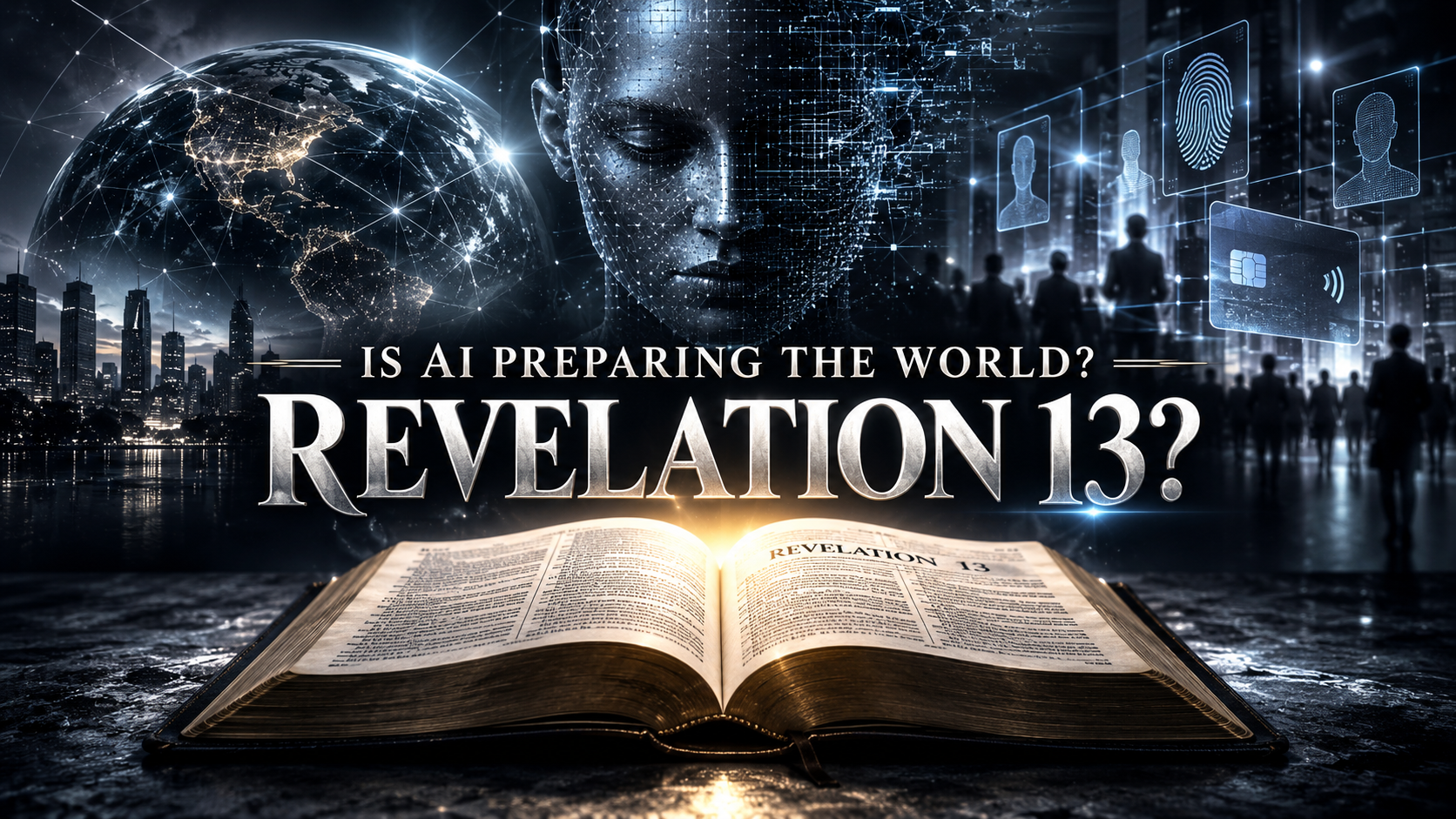
Artificial intelligence can now imitate a human face, clone a voice, generate convincing images, and make decisions at a speed no previous generation could imagine. Digital identity systems are moving from theory into everyday infrastructure. Payments, banking, identification, travel credentials, and access to online services are becoming more connected to digital systems.
For Christians who read Revelation 13, the obvious question is difficult to ignore: are we watching the technological foundations of that chapter being built?
The careful answer is that the Bible does not identify artificial intelligence, digital identity, biometrics, or digital currency as the mark of the beast. Revelation 13 is ultimately about authority, deception, worship, allegiance, and economic exclusion. Yet the technological capabilities developing around us make parts of the system John describes easier to imagine at scale than they were for previous generations. That distinction matters.
What Does Revelation 13 Actually Say?
Revelation 13 describes two beasts. The first receives authority and inspires worldwide astonishment and worship. The second exercises authority on behalf of the first, performs deceptive signs, directs people toward worship, and tells those dwelling on the earth to make an image of the beast.
Then comes one of the chapter’s most discussed passages. Revelation 13:15–17 says the image is given breath so that it can speak, and that people are compelled to receive a mark connected with the ability to buy or sell. The text joins several ideas that Christians should resist separating: deception, worship, political or spiritual authority, an image, allegiance, and control over economic participation.
That is much more specific than simply saying that a future society will use advanced technology. Revelation does not say that a computer becomes the beast. It does not mention artificial intelligence, facial recognition, a digital wallet, a microchip, or a central bank digital currency.
This is why identifying today’s technology as the fulfillment of Revelation 13 goes beyond what Scripture establishes. But asking whether technology could provide mechanisms useful to such a system is a different question.
Why Are Christians Connecting AI to Revelation 13?
One reason is the speaking image in Revelation 13:15. For most of history, an image that appears to speak, interact, persuade, and imitate life belonged to the realm of miracle, illusion, or imagination. Generative AI has changed what an ordinary person can see on a screen.
The National Institute of Standards and Technology is now studying deepfake detection because modern generative AI can produce highly realistic synthetic people and manipulated media. NIST describes the creation of deepfakes as increasingly low-cost and accessible, while noting that detection systems can perform significantly worse when moved from academic testing into real-world conditions. That is a verified technological problem, not a prophetic interpretation.
The Federal Trade Commission likewise reports that impersonation fraud has become an enormous problem. Consumers reported $3.5 billion in losses to imposter scams in 2025, and the agency has specifically warned that AI-generated deepfakes can be used to deceive people.
None of this proves that John’s image is artificial intelligence. The connection is functional rather than textual. AI demonstrates that a society can now create convincing artificial representations, imitate real people, automate persuasion, and distribute those representations globally.
For Christians studying prophecy, that should produce discernment rather than certainty.
Could Digital Identity Change Who Is Allowed to Participate?
Revelation 13 becomes even more provocative when the chapter moves from deception and worship to commerce. The text says a person without the mark cannot buy or sell. Whatever one’s interpretation of the mark, the passage describes an economic restriction connected to allegiance.
Modern digital identity systems show how identity and access can increasingly operate through shared technical infrastructure. The European Commission says every EU member state must make at least one European Digital Identity Wallet available by the end of 2026. The wallet is designed to let citizens and residents prove identity, access public and private services, store credentials, sign documents, and use identity information in situations such as opening a bank account.
The Commission also lists payments among the wallet’s use cases. Importantly, the EU describes the wallet as voluntary and emphasizes privacy, cybersecurity, and user control. It would therefore be inaccurate to call the European Digital Identity Wallet the mark of the beast or to suggest that its stated purpose is religious or political coercion.
What it demonstrates is technological capability. Identity, credentials, services, and financial activity can increasingly interact through interoperable digital systems. That infrastructure can have legitimate benefits while also showing why a future system capable of restricting participation is no longer technologically difficult to imagine.
Is a Cashless Society the Mark of the Beast?
No. Scripture never says that cash disappears before Christ returns, and Revelation 13 does not define the mark as digital money.
That distinction is especially important in the United States. The Federal Reserve states that it has made no decision to implement a U.S. central bank digital currency. Christians should not turn proposals, research, or ordinary electronic payments into facts that do not exist.
The biblical issue is not whether money is paper or digital. Revelation 13:17 focuses on the ability to participate economically being conditioned on the mark. A cashless or highly digital economy could make centralized restrictions easier to administer, but technological convenience is not the same thing as prophetic fulfillment.
This principle applies broadly. A credit card is not the mark. A smartphone is not the mark. A biometric login is not the mark. A digital ID is not the mark. The text points beyond a payment mechanism to a system bound up with the beast’s authority and the question of allegiance.
What About the Mark on the Right Hand or Forehead?
Revelation 13:16 describes the mark as being on the right hand or forehead. Christians disagree about how literally this language should be understood. Futurist interpreters commonly expect a future identifiable mark or mechanism associated with the final beast system. Other interpreters understand the imagery more symbolically, often connecting the hand and forehead with actions, loyalty, worship, and identity.
That disagreement should make us cautious about declaring that a particular modern device fulfills the passage. Our article on the major Christian views of the end times explains why sincere Christians can affirm biblical prophecy while disagreeing about how individual prophetic passages unfold.
There is still an important point on which the text is clearer. Revelation later contrasts those who receive the beast’s mark with those who remain faithful to God. Revelation 14:9–12 places the mark in a context of worship, endurance, and allegiance. The spiritual dimension is not an optional detail.
That makes theories that reduce the mark to accidentally using the wrong technology difficult to reconcile with the broader passage.
Could AI Make End-Times Deception More Powerful?
This may be the more immediate biblical concern.
Jesus repeatedly warned about deception when discussing the end of the age. In Matthew 24:4, His first response to the disciples is a warning not to be led astray. Matthew 24:24 later warns of false christs and false prophets capable of producing signs intended to deceive.
Paul also describes end-times rebellion in terms of deception. In 2 Thessalonians 2:9–12, the coming of the lawless one is associated with false signs and wonders and with people embracing falsehood rather than truth.
AI does not fulfill those passages merely because it can create a fake video. But a world in which seeing and hearing something no longer guarantees that it happened creates obvious new opportunities for deception. That matters in a biblical framework that repeatedly tells believers to test claims rather than surrender discernment.
This also connects with the biblical warnings examined in our study of false prophets and spiritual deception. Technology can amplify a lie, but technology does not create the spiritual problem. The deeper problem remains humanity’s willingness to believe what is false.
Does Technology Prove Revelation Is Unfolding Right Now?
No single technology proves that Revelation 13 is being fulfilled today.
This is where prophecy discussions often move too quickly. A new capability appears, someone notices that it resembles part of a prophetic passage, and resemblance becomes certainty. That is not a reliable method of biblical interpretation.
We used the same standard when examining whether 3I/ATLAS should be treated as a prophetic celestial sign. Scripture can describe a category of future events while a modern event merely resembles that category. Similarity is worth investigating, but it does not establish fulfillment.
Revelation 13 contains a network of claims. A responsible case for fulfillment would have to account for the chapter’s authority structures, worship, deception, image, mark, economic restriction, and relationship to the wider narrative of Revelation. Pointing to one new technology is not enough.
Why Does Today’s Technology Still Matter?
Because prophecy does not have to name a technology for technological change to alter what humans are capable of doing.
A century ago, instant global communication was limited. Today billions of people can receive the same message almost immediately. Artificial intelligence can generate persuasive content at enormous scale. Digital identity systems can authenticate people across services. Electronic financial systems can approve or deny transactions in fractions of a second.
Again, those systems are not inherently the beast system. Many exist for legitimate reasons such as fraud prevention, privacy, security, convenience, and access. Christians do not need to pretend that every technological advance has a sinister purpose.
But neither should we ignore the larger development. Systems capable of verifying identity, controlling access, distributing persuasive synthetic media, and mediating economic activity increasingly exist in the same digital environment. That does not prove Revelation 13. It does make the mechanisms described there easier for a modern reader to conceive.
What Is the Strongest Argument Against Connecting AI to Revelation?
The strongest objection is simple: John never says anything about artificial intelligence.
That objection is correct. Reading AI directly into Revelation risks replacing the biblical text with our own generation’s anxieties. Christians have repeatedly interpreted new technologies through apocalyptic expectations, and many confident identifications have failed.
There is also a danger in becoming so focused on mechanisms that we miss Revelation’s central theological claim. The conflict is about whom humanity worships and obeys. The beast demands what belongs to God.
That is why the best conclusion is narrower than either extreme. We should not say, “AI is Revelation 13.” We also do not need to say technological developments are irrelevant. Technology can create capabilities that a coercive system might use without being the prophetic system itself.
What Should Christians Watch For?
Christians should watch patterns more carefully than products.
Watch the relationship between identity and access. Watch whether systems designed for convenience can also become mechanisms of coercion. Watch the growing difficulty of separating authentic communication from synthetic deception. Watch how political, economic, and technological power becomes concentrated. Most importantly, watch any movement that demands the kind of allegiance or worship Scripture reserves for God.
But watch without panic. Jesus did not tell His followers to identify every invention before anyone else. He told them not to be deceived, to endure, to remain faithful, and to be ready.
That is also the principle behind our broader examination of why Christians believe the end may be near. Biblical watchfulness is not the same as declaring every headline a prophecy.
Final Thoughts: Is AI Preparing the World for Revelation 13?
Artificial intelligence is not identified in the Bible as the beast, the image of the beast, or the mark. Digital identity is not identified as the mark. Cashless payments are not identified as the mark. Scripture does not give us permission to make those declarations.
What we can say is more interesting. Technologies now exist that can imitate human communication, manufacture persuasive synthetic media, authenticate identity across services, connect identity with financial activity, and potentially control access at extraordinary scale. Revelation 13 describes a future or symbolic system, depending on one’s interpretive framework, involving deception, allegiance, an image, and the ability to buy or sell.
The overlap in capability deserves serious examination. The identification of fulfillment requires evidence we do not yet have.
For Christians, the central question is therefore not, “Which app is the mark of the beast?” It is whether we are becoming the kind of people who can recognize deception, resist coercion, and remain faithful to Christ when allegiance has a cost.
Continue the Prophecy Journey
Signs Before the Silence explores the larger biblical framework behind the signs, warnings, and questions Christians are watching today. If this article raised questions about how modern developments fit into biblical prophecy, read the First Look and continue the study from Scripture rather than fear.