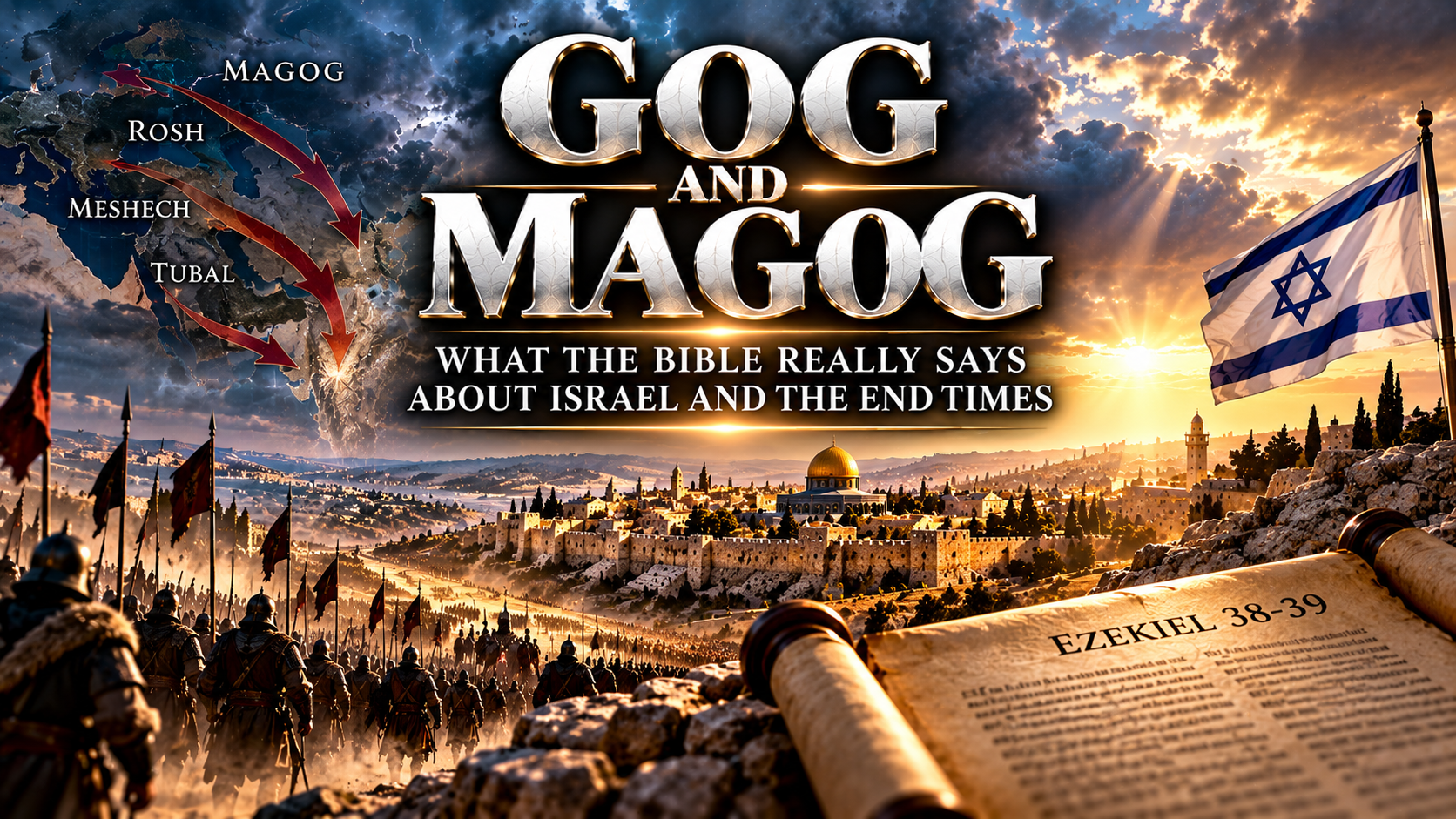
For generations, prophecy teachers have pointed to Ezekiel 38 and made a startling claim: Russia is the great northern power that will lead an end-times invasion of Israel.
The argument can sound convincing. Ezekiel describes Gog coming from the “far north.” Some Bible translations call Gog the prince of “Rosh, Meshech, and Tubal.” Modern prophecy maps have connected Rosh with Russia, Meshech with Moscow, and Tubal with Tobolsk. Today, Russia and Iran maintain a strategic relationship while the Middle East remains one of the most volatile regions on earth.
So are we watching Ezekiel’s coalition form in real time?
Possibly, but there is a major problem with saying the case is already solved. Ezekiel never uses the word Russia. The ancient names in the prophecy have their own historical setting, and several popular modern identifications depend more on similar-sounding words than demonstrated linguistic connections.
To understand whether Russia could be Gog, we first have to ask a more important question: what does Ezekiel 38–39 actually predict?
Who Is Gog in Ezekiel 38?
Ezekiel 38 begins with God commanding the prophet to set his face against “Gog, of the land of Magog.” Gog is presented as a ruler associated with Meshech and Tubal. He leads an enormous multinational force against Israel.
The text names Persia, Cush, and Put among his allies. It also includes Gomer and Beth-togarmah “from the far north,” along with many peoples. The coalition comes against a land restored from war whose people have been gathered from many nations.
Ezekiel repeatedly places the attack in a future setting. Ezekiel 38:8 speaks of “the latter years,” while verse 16 says the invasion will occur “in the latter days.” The attack ultimately becomes the setting for God to display His holiness before the nations.
That much is explicit in the prophecy. Identifying each ancient name with a modern nation is a separate interpretive step.
Does the Bible Actually Say Gog Is Russia?
No. The Bible never explicitly identifies Gog, Magog, Rosh, Meshech, or Tubal with the modern Russian Federation.
The Russia interpretation developed from several arguments. Gog’s forces come from the north. Some translations render Ezekiel 38:2 as “prince of Rosh, Meshech, and Tubal.” Prophecy teachers then noticed that Rosh sounds somewhat like Russia, Meshech like Moscow, and Tubal like Tobolsk.
Those similarities became deeply embedded in popular end-times teaching. But similar sounds do not establish historical identity.
The Hebrew word rosh normally carries the sense of head or chief. Translators disagree about whether it functions in Ezekiel 38 as a proper place name, “Rosh,” or as part of the title “chief prince.” Even if Rosh is a proper name, that does not demonstrate that the ancient name refers to Russia.
This is where responsible prophecy study has to separate a possible modern application from what the biblical text itself establishes.
Are Meshech and Tubal Really Moscow and Tobolsk?
The historical evidence points elsewhere.
Meshech and Tubal were names known in the ancient Near Eastern world. They are commonly associated with peoples or territories in Anatolia, the region that includes much of modern Turkey. Ancient Assyrian sources contain names corresponding to these groups, which makes an Anatolian identification far stronger than a connection based on the modern names Moscow and Tobolsk.
That matters because Ezekiel was speaking through geographical names meaningful within his own ancient context. We should understand those names there before moving them onto a twenty-first-century map.
None of this proves that people from the territory of modern Russia could not participate in a future fulfillment. It does mean “Meshech sounds like Moscow” is not sufficient evidence.
What About the “Far North”?
Ezekiel does emphasize the north. Gog is described as coming from the “uttermost” or “far” north in Ezekiel 38:15 and 39:2, depending on translation.
Russia is certainly north of Israel, which helps explain why the identification became attractive. But many territories lie north of Israel. Ancient Anatolia is also north of Israel, and several names in Ezekiel’s list have strong connections to that broader region.
The phrase therefore establishes direction, not a modern national border.
If future events eventually reveal that a Russian-led force is the coalition Ezekiel saw, the identification should rest on the complete correspondence of the prophecy, not simply the direction “north.”
Who Are the Nations in Ezekiel’s Coalition?
Ezekiel’s list is one of the reasons the prophecy continues to attract attention.
Persia is the easiest name for modern readers to recognize historically. The ancient Persian heartland corresponds substantially with modern Iran. Cush is usually associated with lands south of Egypt, often connected with Nubia and areas of modern Sudan or Ethiopia. Put is generally associated with North Africa. Gomer and Beth-togarmah point toward peoples associated with Anatolia and surrounding northern regions.
Yet even here we need caution. Ancient peoples, kingdoms, and territories do not map perfectly onto modern nation-states. Borders move. Populations migrate. Political identities change.
Ezekiel’s theological picture is clearer than a modern political map: Gog gathers a broad coalition against the people God has restored, and God Himself defeats the invaders.
Why Does Iran Make This Question Feel So Relevant Today?
Because Persia is actually named in Ezekiel 38:5.
Unlike attempts to derive Russia from Rosh, connecting biblical Persia with the historical Persian realm centered in modern Iran has a much firmer geographical basis. That makes Iran’s modern relationships understandably interesting to Christians who read Ezekiel 38 futuristically.
Russia and Iran have also strengthened their formal relationship. Russia ratified a Comprehensive Strategic Partnership treaty with Iran in 2025, and Russian and Iranian leaders continued publicly affirming stronger bilateral relations in 2026.
That is a verified geopolitical development. It is not proof of Ezekiel 38.
A modern Russia-Iran partnership can resemble one possible configuration imagined by futurist interpreters without demonstrating that Gog’s invasion has begun. The prophecy requires much more than diplomatic cooperation between two countries.
What Would Have to Happen for Ezekiel 38 to Be Fulfilled?
This is where headline-driven prophecy claims often move too quickly.
Ezekiel describes an actual attack. Gog does not merely sign treaties, conduct military exercises, or criticize Israel. He assembles many nations and comes against the land like a storm.
The prophecy also describes Israel in a particular condition. Its people have been gathered from the nations and are dwelling in a land restored from devastation. The language of security in Ezekiel 38:8 and 38:11 has generated substantial debate over exactly what conditions must exist before the invasion.
Then God intervenes dramatically. Ezekiel describes a great earthquake, panic within Gog’s forces, pestilence, bloodshed, torrential rain, hailstones, fire, and sulfur. The result is not an ambiguous military outcome. God says the nations will know Him when He vindicates His holiness.
A genuine fulfillment therefore has a much larger evidentiary footprint than “Russia and Iran are allies.”
Does Israel’s Modern Restoration Fulfill Ezekiel’s Setting?
Many futurist Christians see the modern restoration of Israel as one of the most significant reasons to read Ezekiel 38 as still future.
The prophecy speaks of people gathered from many nations into the mountains of Israel. The establishment of the modern State of Israel in 1948 and subsequent Jewish immigration from around the world naturally draw attention to that language.
Other Christian interpreters understand Ezekiel’s restoration promises through the return from Babylonian exile, the messianic people of God, or a combination of historical and eschatological fulfillment. The disagreement is not over whether Ezekiel speaks about restoration. It is over how that restoration relates to modern Israel and the final events of history.
Our overview of Christian views of the end times explains why sincere Christians can read the same prophetic texts through different frameworks.
When Does the Gog and Magog War Happen?
Ezekiel does not give readers a modern calendar date.
Futurist interpreters have placed the invasion at several different points: before the Tribulation, near its beginning, during it, near Christ’s return, or in connection with other final conflicts. The text’s “latter days” language supports an eschatological reading, but constructing an exact chronology requires combining Ezekiel with other prophetic passages.
That creates another reason for humility. Christians who agree that Ezekiel 38–39 points toward a future climactic conflict can still disagree about where it belongs in the sequence.
If you are trying to understand that broader sequence first, what happens at the end of time according to the Bible provides the larger framework before attempting to place individual prophetic events.
Is Gog the Antichrist?
Ezekiel does not call Gog the Antichrist.
Some interpreters connect Gog with the final anti-God ruler described elsewhere in Scripture. Others see Gog as a separate leader whose invasion occurs at another point in the end-times sequence. Still others understand Gog more symbolically as the embodiment of the nations’ final hostility toward God and His people.
The safest statement is the one the text allows: Gog is the leader of the coalition Ezekiel describes. Identifying him with another prophetic figure requires theological synthesis beyond Ezekiel’s explicit wording.
The same discipline matters when discussing Revelation 13 and modern technology. A contemporary development can help us understand how a biblical scenario might operate without proving that a specific prophetic figure has already appeared.
Why Does Revelation Mention Gog and Magog Again?
Revelation 20:7–10 introduces Gog and Magog after the thousand years, when Satan is released and deceives the nations at the four corners of the earth. They gather for battle against God’s people and are destroyed by fire from heaven.
John’s use of the names is significant. “Gog and Magog” now represents hostile nations gathered from across the earth, not merely two modern countries.
Christians disagree about the relationship between Ezekiel 38–39 and Revelation 20. Some see the passages as describing the same ultimate conflict. Others distinguish Ezekiel’s invasion from Revelation’s post-millennial rebellion while recognizing that John deliberately uses Ezekiel’s imagery.
Either way, Revelation warns against shrinking Gog and Magog into a simplistic newspaper code. The biblical theme is ultimately about the nations gathering against God and God decisively defeating them.
Could Russia Still Be Involved?
Yes. Rejecting a weak argument is not the same as proving the opposite conclusion.
Russia is a major military power north of Israel. It has maintained important relationships throughout the Middle East, including with Iran. A future coalition could involve Russia. Scripture does not require us to declare that impossible.
But “could be involved” and “the Bible identifies Russia as Gog” are very different claims.
The first is a geopolitical possibility. The second claims biblical certainty. The evidence currently supports the first far more comfortably than the second.
Are Russia and Iran Forming the Ezekiel 38 Coalition Right Now?
There are enough parallels to make the question worth asking, but not enough to call the prophecy fulfilled.
Iran corresponds historically to Persia, one of the named members of Gog’s coalition. Russia and Iran have a strategic partnership. Regional alliances and hostilities involving Israel continue to shift rapidly.
But Ezekiel’s coalition contains more nations, has a specific purpose, invades Israel, and experiences extraordinary divine judgment. Those elements have not been established merely by the existence of present alliances.
This is similar to the way we should evaluate red-heifer developments and Third Temple prophecy. Preparatory conditions or intriguing parallels can deserve attention without becoming proof that the prophetic event itself has begun.
What Should Christians Actually Watch For?
Watch for convergence rather than isolated resemblance.
A future event would become substantially more significant if a coalition corresponding convincingly to Ezekiel’s nations formed for the purpose described in the text, Israel matched the relevant setting, the coalition actually moved against Israel, and the extraordinary outcome followed.
Christians should also watch their own tendency to retrofit every geopolitical rival into prophecy. Russia has occupied the Gog role in popular American prophecy teaching for decades. Earlier generations made similarly confident identifications using the political threats of their own time.
The biblical text should interpret the headline. The headline should not rewrite the biblical text.
Does Ezekiel 38 Mean the End Is Near?
Ezekiel 38–39 belongs to one of Scripture’s great visions of God defeating the enemies who rise against His purposes. For Christians who read the passage futuristically, modern Israel and changing Middle Eastern alliances naturally make the prophecy feel immediate.
But Scripture does not authorize us to turn geopolitical resemblance into a countdown clock.
That is also why Paul’s warning about “peace and safety” in 1 Thessalonians 5:3 matters. Biblical watchfulness is not the same thing as searching speeches, treaties, and maps for a single phrase or name that lets us announce the date.
Jesus calls His followers to readiness. Prophecy should produce faithfulness, discernment, and hope, not certainty beyond what God has revealed.
Final Thoughts: Is Russia the Gog of Magog?
Ezekiel 38 does not give us enough evidence to say with certainty that Russia is Gog.
The prophecy does describe a powerful leader from the north who gathers a multinational coalition against restored Israel in the latter days. Persia is explicitly included. Those details make modern geopolitical developments worth watching.
But the familiar equations Rosh = Russia, Meshech = Moscow, and Tubal = Tobolsk are not strong enough to carry the argument. Ancient geography points Meshech and Tubal toward Anatolia, while the identity of Gog and Magog remains debated. Russia could conceivably participate in a future fulfillment without being encoded in those names.
The more important certainty is the one Ezekiel emphasizes. The nations do not control the ending. God does. Gog’s attack becomes the stage on which God declares, “I will magnify Myself and sanctify Myself, and I will be known in the eyes of many nations.”
That is the center of the prophecy. Not Russia. Not speculation. God’s sovereignty over the final outcome.
Continue the Prophecy Journey
Signs Before the Silence examines the biblical signs and prophetic questions that make today’s world feel increasingly familiar to readers of Scripture. If Ezekiel 38 has you asking which modern developments matter and which connections go beyond the text, read the First Look and continue the investigation with Scripture at the center.
Sources and Further Reading
- Religions: “Marking Nations Around New Jerusalem: The Mental Map of Ezekiel in the Babylonian Context”
- The Gospel Coalition Bible Commentary: Ezekiel
- Reformation Study Bible notes on Ezekiel 38:2
- President of Russia: Ratification of the Russia-Iran Comprehensive Strategic Partnership treaty
- President of Russia: April 2026 Russia-Iran presidential discussion