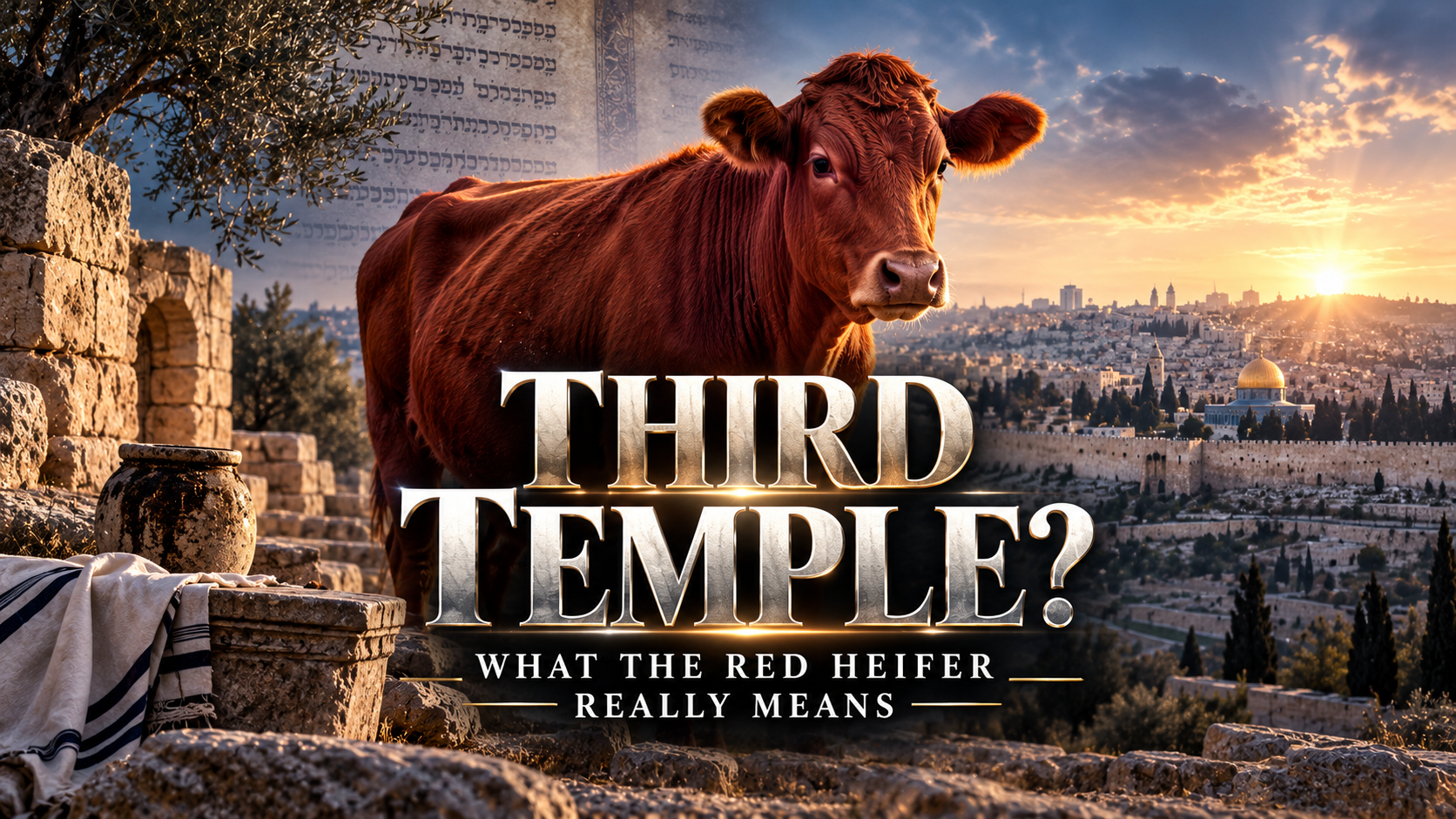
For years, Christians watching biblical prophecy have followed reports about red heifers in Israel with unusual attention. Recent headlines and viral posts have gone further, claiming that red-heifer ashes have been prepared and that one of the final barriers to rebuilding the Temple in Jerusalem may have fallen.
If true, that would sound enormous. Daniel speaks of sacrifice being stopped. Jesus warns about an “abomination of desolation” standing in a holy place. Paul describes the “man of lawlessness” taking his seat in the temple of God. Revelation describes worshipers and an altar connected with a temple. For Christians who interpret these passages as future events, renewed Temple worship has obvious prophetic implications.
But there is a problem with the viral version of the story: the organization actually conducting much of the red-heifer work says the widely discussed ceremony was only a practice exercise. The ashes were not valid, the animal used was deliberately unqualified, and the current candidate heifers have not been definitively approved.
So did Israel just take a major step toward the Third Temple? Something significant is happening, but the biblical and factual story is more complicated than the headlines suggest.
What Is the Red Heifer in the Bible?
The red heifer comes from Numbers 19, not Revelation. God commands Moses and Aaron to have Israel bring a red heifer “without defect or blemish” that has never been under a yoke. The animal is taken outside the camp, slaughtered, and burned with cedar wood, hyssop, and scarlet material. Its ashes are then used with water in a purification ritual.
The purpose is specific. Numbers 19 deals with ritual impurity associated with contact with a dead body. Someone who becomes ceremonially unclean through death is sprinkled with the purification water on the third and seventh days before becoming clean again.
This makes the red heifer important to Jewish Temple practice, but Numbers 19 never calls it an end-times sign. It gives Israel a purification commandment. The prophetic significance Christians attach to the red heifer comes from connecting that commandment with passages they believe describe renewed Temple worship in the future.
Why Would a Red Heifer Matter for a Future Temple?
Temple service involves questions of ritual purity. The Temple Institute in Jerusalem, an organization devoted to preparing for renewed Temple worship, describes red-heifer ashes as a prerequisite for the complete restoration of Temple service. It has researched the laws surrounding the rite, trained priests for Temple responsibilities, prepared ritual vessels, and worked with red heifers brought to Israel.
The organization also makes an important qualification. Certain offerings with fixed times may, under its understanding of Jewish law, proceed even when the nation is ritually impure. The red heifer is therefore not a magical switch that automatically makes construction or every form of worship possible.
That matters because prophecy discussions often compress a long chain of events into one sentence: “They have a red heifer, therefore the Third Temple can now be built.” Jewish law, Temple preparations, political realities, control of the Temple Mount, and the biblical question of prophecy are separate issues.
What can be verified is that serious religious preparations exist. What cannot be established is that possessing a qualifying heifer would itself trigger construction of a Temple.
Were Red-Heifer Ashes Actually Prepared?
This is where recent reporting became especially confusing.
The Temple Institute issued a direct clarification after claims circulated about red-heifer ashes. According to the Institute, a practice exercise was conducted in the Samarian hills as part of its effort to learn the complicated procedure. It says the event was a simulation, not a valid performance of the biblical rite.
The organization says the heifer used for the exercise was intentionally unqualified. It had physical defects. The ceremony did not occur on the Mount of Olives facing the Temple site as required under the Institute’s interpretation of Jewish law. The priestly garments were not consecrated, and people who were ritually impure handled ash samples.
The Institute’s conclusion is unusually direct: the ashes from that exercise are ineligible for purification, and claims that they are valid are mistaken.
That correction should govern how Christians discuss the story. A rehearsal is significant because it demonstrates preparation and intent. A rehearsal is not the same thing as fulfillment of the rite.
Are There Qualified Red Heifers in Israel Right Now?
There are red heifers being monitored in Israel, but their final status is not as certain as many headlines imply.
The Temple Institute says four red heifers are currently at its Shiloh site and that their halakhic status has not been definitively determined. The organization says it intends to perform the actual rite when it has a qualifying animal and when the other requirements can be met.
This is important because the standards extend far beyond an animal simply appearing red in a photograph. Numbers 19 requires an animal without defect that has never borne a yoke. Later Jewish law developed detailed requirements concerning color, defects, work performed by the animal, and the ceremony itself.
A viral image of a red cow therefore proves almost nothing by itself. The relevant question is whether recognized authorities applying the required rules determine that an animal qualifies and whether the ceremony can be conducted according to those rules.
Does the Bible Predict a Third Temple?
This is where the discussion moves from verified events into Christian interpretation.
The phrase “Third Temple” does not appear in the New Testament. Nevertheless, several passages lead many futurist Christians to expect a future Temple or functioning sanctuary in Jerusalem.
Daniel 9:27 describes a coming figure who causes sacrifice and offering to cease and connects that event with an abomination. Daniel 12:11 again links the removal of the regular sacrifice with an abomination that makes desolate.
In Matthew 24:15, Jesus tells His listeners to recognize “the abomination of desolation spoken of by the prophet Daniel” standing in the holy place. Christians disagree about whether Jesus was speaking primarily about events surrounding Jerusalem’s destruction in AD 70, a future end-times event, or a pattern with more than one fulfillment.
Paul adds another passage in 2 Thessalonians 2:3–4. He describes the “man of lawlessness” exalting himself and taking his seat “in the temple of God,” proclaiming himself to be God. Futurist interpreters commonly see this as evidence that a Temple will exist during the final events preceding Christ’s return.
Revelation 11:1–2 then describes John being told to measure the temple of God, the altar, and those who worship there while leaving the outer court unmeasured.
Taken together, these texts explain why a future Temple occupies such an important place in many end-times frameworks. They do not, however, tell us that any particular modern Temple organization or red heifer is the fulfillment of those passages.
Do All Christians Believe the Temple Must Be Rebuilt?
No. The answer depends heavily on how a Christian interprets biblical prophecy.
Many dispensational and futurist premillennial Christians expect a literal future Temple because they read Daniel, Matthew 24, 2 Thessalonians 2, and Revelation as describing events still ahead. In that framework, renewed sacrifice and a future desecration require some form of functioning sanctuary.
Other Christians understand much of this language through the first-century destruction of Jerusalem, apocalyptic symbolism, or the New Testament’s teaching about Christ and His people as God’s Temple. They therefore do not regard construction of a Third Temple as a required prophetic milestone.
Our guide to the major Christian views of the end times explains why believers who affirm the authority of Scripture can reach different conclusions about the chronology and literalness of prophetic passages.
That disagreement does not make the modern developments irrelevant. It tells us what kind of claim we are making. “A Jewish organization is preparing for Temple service” is a verifiable fact. “This preparation fulfills biblical prophecy” is a theological conclusion requiring additional argument.
Why Is the Temple Institute Important to This Story?
Because it turns what can sound like a purely hypothetical prophecy discussion into an observable modern religious movement.
The Temple Institute openly states that it is preparing for renewed Holy Temple service. It has created ritual vessels, conducts Temple-related education, trains kohanim for priestly responsibilities, studies the red-heifer laws, and supports efforts to raise a qualifying animal in Israel.
Its own material describes red-heifer preparation as part of that larger goal. This does not mean the Israeli government has decided to build a Temple. The Temple Institute is a religious organization, not the State of Israel, and its goals should not be attributed to all Israelis or all Jews.
That distinction is essential. Saying “Israel is rebuilding the Temple” suggests a governmental or national project that the available evidence does not establish. Saying “Jewish religious organizations in Israel are actively preparing for renewed Temple worship” is both more accurate and, from a prophecy perspective, still remarkable.
Would a Third Temple Be Easy to Build?
No. The Temple Mount is one of the most religiously and politically sensitive places in the world.
The site is sacred to Jews as the location of the First and Second Temples. It is also home to the Al-Aqsa Mosque and the Dome of the Rock and is one of Islam’s holiest sites. Any attempt to radically change the religious status of the compound would carry consequences far beyond an ordinary construction project.
The Temple Institute itself acknowledges that the timing of a future Temple is not under its control. It can prepare vessels, educate priests, study ritual law, and raise animals. Those preparations do not give it political authority over the Temple Mount.
This is another reason a red heifer cannot be treated as a countdown clock. Even if an unquestionably qualified animal became available tomorrow, enormous religious, legal, political, and security questions would remain.
Could the Red Heifer Still Be Prophetically Significant?
Potentially, but the wording matters.
If a future Temple is required for the events described by Daniel, Jesus, Paul, and Revelation, then practical preparations for Temple worship would naturally interest Christians who hold that interpretation. A successful red-heifer rite could remove one religious obstacle to full ritual purity under the Temple Institute’s framework.
That is a legitimate contemporary parallel. It is not the same thing as saying Numbers 19 predicts a red heifer will appear immediately before the Tribulation.
The Bible gives no date for the next red heifer. It does not say the discovery of one starts a seven-year clock. It does not tell Christians to calculate Christ’s return from an animal’s age. Those claims require information Scripture does not provide.
The same discipline applies to other dramatic developments. In our investigation of 3I/ATLAS and biblical celestial signs, we found that an event can resemble a prophetic category without proving fulfillment. Prophecy deserves more than pattern matching.
What Would Actually Make This Story More Significant?
Several developments would materially change the analysis.
A recognized qualifying red heifer being formally approved would be more significant than the existence of candidate animals. A valid preparation ceremony would be more significant than a rehearsal. Actual use of purification water would be more significant than preparations for producing it.
Beyond the heifer itself, formal moves toward renewed sacrificial worship or a functioning sanctuary would dramatically raise the relevance of passages involving sacrifice and the Temple. Political or religious changes affecting access to the Temple Mount would matter far more than social-media speculation.
Until then, Christians should distinguish readiness from completion. Preparations can be historically interesting and potentially prophetically relevant without being the event Scripture describes.
What Should Christians Watch Without Falling Into Sensationalism?
Watch primary sources. If a claim concerns a red heifer, ask what the organizations and rabbinic authorities actually responsible for the project say. If a headline claims ashes are valid, look for confirmation that the ritual requirements were met rather than repeating a viral post.
Watch developments connected to Temple worship, not merely animals. The larger prophetic question involves sacrifice, worship, authority, Jerusalem, and the passages Christians believe describe a future desecration.
And watch Scripture more closely than the news. Our article on why Christians believe the end may be near examines the broader collection of biblical and contemporary questions that lead believers to watch current events. No single headline carries the entire case.
The goal is not to become the first person to announce fulfillment. It is to recognize what Scripture actually says if significant events do occur.
Final Thoughts: Did Israel Just Move Closer to the Third Temple?
There are real preparations underway in Israel for renewed Temple worship. The red-heifer project is real. Temple vessels, priestly education, ritual research, and practical exercises are real. Christians interested in future-Temple prophecy have legitimate reasons to pay attention.
But the most dramatic recent claim needs correction. The widely discussed red-heifer ceremony was a rehearsal. According to the Temple Institute itself, the animal was not qualified and the resulting ashes cannot be used for purification. The status of the current candidate heifers remains unresolved.
So we should neither dismiss the story nor inflate it. We are watching people prepare for religious practices that disappeared with the ancient Temple, and that fact is historically unusual. Whether those preparations eventually intersect with the events described in biblical prophecy remains an open theological question.
Jesus’ command was not to build faith around rumors. It was to remain watchful without being deceived.
Continue the Prophecy Journey
Signs Before the Silence examines the larger biblical framework behind Israel, prophecy, Revelation, deception, and the signs Christians are watching today. If the red-heifer story made you wonder how modern events should be compared with Scripture, read the First Look and continue the investigation with the biblical text at the center.